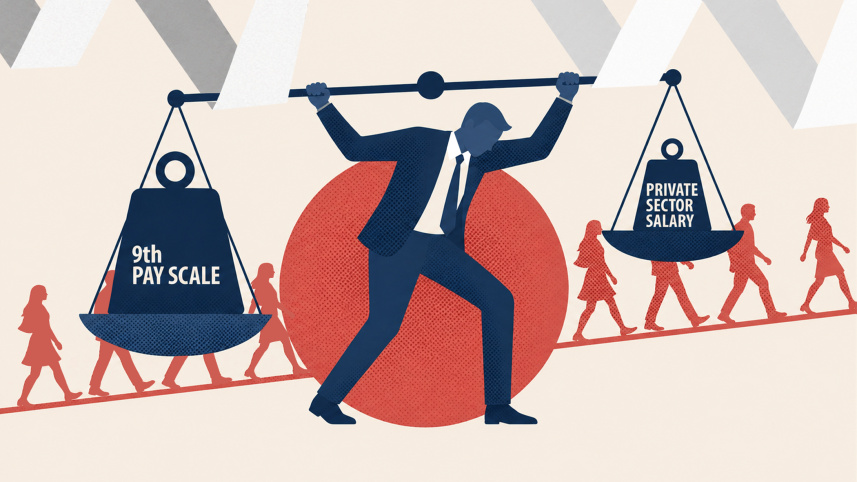
Inside the Double-Shift Lives of the Urban Middle Class
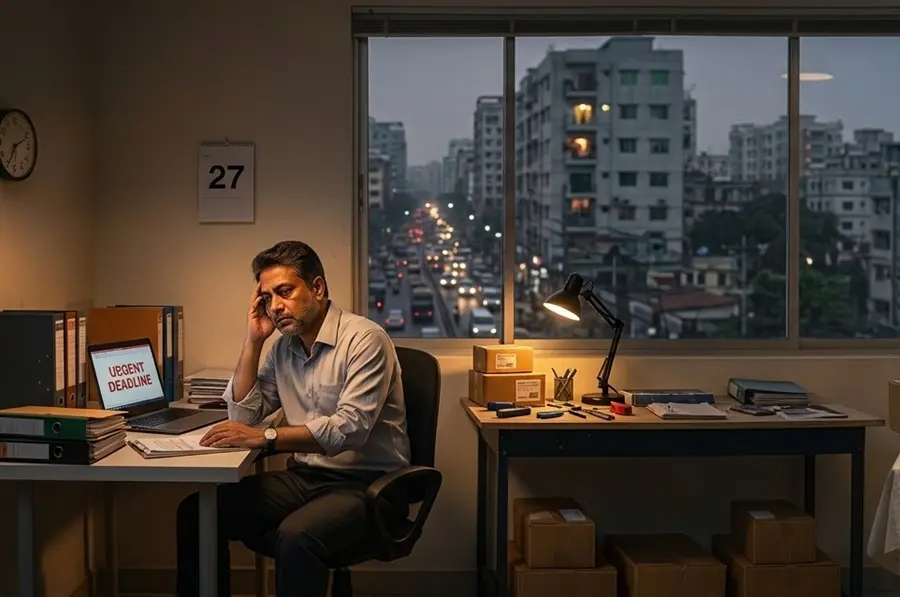
For many middle-class families in Dhaka, the weekend is gradually losing its traditional meaning.
Friday and Saturday are no longer necessarily days for rest, family gatherings or recovery from the working week. They have increasingly become additional working days—time to manage a side business, complete freelance assignments, tutor students, handle unfinished office work or simply catch up with household responsibilities.
Behind this shift is a basic financial reality.
Rent, children’s education, tuition and stationery, medical expenses for elderly parents, utilities, transportation, groceries and other necessities can consume a substantial portion of a household income.
For families depending on a single breadwinner, the pressure can be even greater.
As a result, some urban workers are effectively living a double-shift life: one job provides their primary income and professional identity, while another stream of work helps keep household finances manageable.
THE DOUBLE-SHIFT LIFE
Ali Hasan from Mohammadpur represents one version of this routine.
He works in a corporate job but also operates a small restaurant.
His day begins at the restaurant, where he works during the breakfast period from around 6am to 8am. He then leaves for his corporate office and works from 9am until 5pm.
His working day does not end there.
After returning to the restaurant in the evening, he checks supplies, supervises employees, serves customers and manages the business until around 11pm.
On weekends, the restaurant can keep him occupied from early morning until late at night.
"This double shift is complicating my life," Hasan says. "But if I don’t have a side business, it is hard for me to sustain my family, so it is necessary for me."
The important distinction is why people take on additional work.
For some, a side business is an entrepreneurial ambition. For others, it is primarily a response to the gap between household income and living costs.
WHEN FAMILY TIME BECOMES SCARCE
One of the first things squeezed by a double-shift routine is time with family.
A parent may technically be at home while still thinking about office deadlines, customer messages, sales, inventory or the bills due the following day.
Meals become rushed. Conversations become shorter. School programmes, parent-teacher meetings and family occasions become easier to miss.
Children may gradually become accustomed to seeing a working parent only early in the morning or late at night.
The family still lives under one roof, but opportunities for sustained conversation become less frequent.
The problem is not necessarily a lack of affection or commitment.
After working for 12 or 14 hours, people can simply run out of the time and emotional energy required to listen carefully, help solve problems or participate fully in family life.
Household responsibilities can add another layer of pressure.
When one person spends long hours earning outside the home while another carries most of the cooking, childcare, care for elderly relatives and household administration, the arrangement can create exhaustion on both sides.
Financial necessity may explain the arrangement without making the workload any lighter.
THE SIDE-INCOME ECONOMY
The forms of additional work available to urban residents have also expanded.
Some people operate online businesses after office hours. Others take freelance assignments in writing, design, accounting, programming or digital marketing.
Tutoring and coaching remain common sources of extra income, while restaurants and retail businesses provide other part-time opportunities.
Digital platforms have also made delivery and ride-sharing work accessible to people seeking additional earnings.
These activities are often grouped together under the increasingly popular idea of a "side hustle".
But the same term can describe very different realities.
For one person, a side hustle may be a deliberate path towards entrepreneurship and financial independence.
For another, it may be necessary because a regular salary no longer provides the level of financial security the household requires.
That distinction matters.
When additional work is optional, it can create opportunity. When it becomes essential, the cost is often measured not only in hours worked but in the parts of life those hours replace.
EARNING MORE, HAVING LESS TIME
The contradiction facing many urban workers is that additional income may improve their ability to pay for a better home, education, healthcare or other necessities while simultaneously reducing the time available to enjoy those improvements.
Rest becomes negotiable.
Exercise can disappear from the routine. Social relationships receive less attention. Family outings become difficult to arrange.
Even weekends can turn into extensions of the working week.
Over time, chronic exhaustion risks becoming accepted as an ordinary feature of middle-class life rather than a warning that the balance between income and wellbeing has become unsustainable.
SURVIVAL SHOULD NOT MEAN ISOLATION
The answer is not simply to tell people to stop earning additional income.
For many households, developing a second income stream is a rational response to financial uncertainty.
New skills, freelance work and small businesses can also create valuable long-term opportunities.
The challenge is preventing financial survival from consuming every available hour.
Families can start by having clearer conversations about money, working hours and household responsibilities.
Domestic work can be shared more deliberately, particularly when both partners are carrying demanding workloads.
Quality family time does not always require an entire free day.
A regular breakfast together, a weekly walk or even a fixed hour without work calls and mobile notifications can create space for relationships that otherwise get pushed aside.
Employers also have a role.
An employee working additional hours outside the office may already be operating with limited physical and mental reserves. Excessive workloads and unnecessarily rigid working practices can make that pressure worse.
Reasonable workloads, appropriate flexibility and access to wellbeing support can help employees remain productive without requiring them to sacrifice every part of their personal lives.
THE DISAPPEARING WEEKEND
For a growing section of the urban middle class, additional income is becoming less about luxury and more about maintaining financial stability.
That reality makes the side-income economy difficult to dismiss.
But every additional hour of paid work has an opportunity cost.
People still need sleep. Parents still need time with their children. Couples need conversations that are not about bills. Families need moments that are not organised around the next deadline or payment.
The double-shift life may help households survive financial pressure, but it should not become a permanent expectation that earning enough requires surrendering almost all personal time.
As the urban middle class works longer to protect its standard of living, the disappearing weekend is becoming a symbol of a broader problem: people may be finding more ways to earn, while having increasingly less time left to live.