Government Jobs Are Getting Better, but What About the Private Sector?
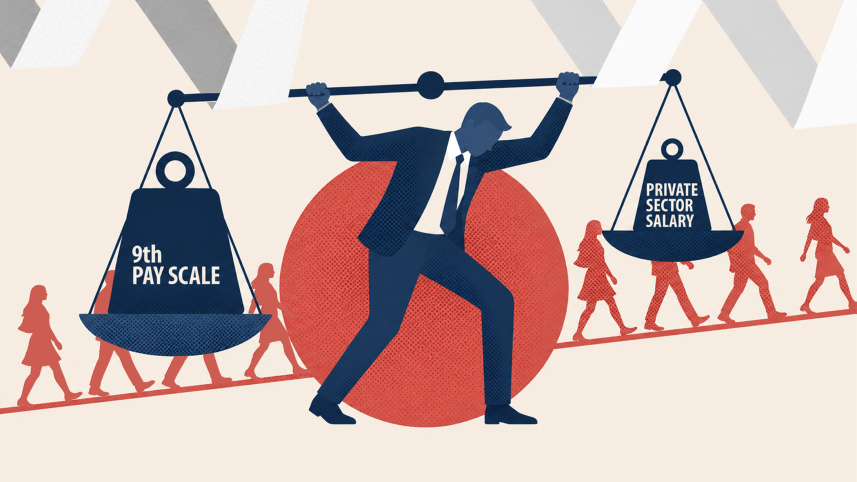
The newly approved ninth National Pay Scale has significantly improved the financial appeal of government employment in Bangladesh. While the salary adjustment may be justified after years of inflation and the long gap since the previous pay scale, it also raises a broader question about the choices facing young workers.
For many graduates, preparing for a government job is already a long-term investment. Candidates often spend years moving through preliminary tests, written examinations and interviews, while spending additional time and money on coaching, guidebooks and preparation.
During that period, many could otherwise have entered private employment, learned technical or professional skills, joined startups or built practical workplace experience. The stronger the incentives attached to public employment become, the more rational it may appear to remain in the government-job queue.
Under the new pay structure, basic salaries across government grades are set to rise substantially. At the same time, government jobs continue to offer something many private employers cannot match: predictable pay progression, pension benefits and a relatively high degree of job security.
That contrast matters because starting salaries in parts of the private economy remain modest. Fresh graduates in many local firms may begin with salaries in the Tk 20,000 to Tk 30,000 range, while some professionals with demanding qualifications also start at relatively low levels.
At the lower end of the labour market, conditions can be even more difficult. Workers in labour-intensive sectors may face long hours, weak bargaining power and salaries that barely keep pace with living costs.
The issue, therefore, is not that government jobs have become too attractive. The deeper problem is that many private-sector alternatives remain insufficiently attractive.
If a young graduate can expect greater security, clearer salary progression and better long-term benefits in a government position, continuing to prepare for such a job can appear economically reasonable.
For the wider economy, however, this creates an opportunity cost. Years spent preparing for a small number of public jobs can mean delayed entry into productive employment, slower skill development, fewer new businesses and reduced professional experience.
The private sector is also facing its own structural pressures. Private investment has weakened as a share of GDP, while credit growth has slowed and businesses remain cautious because of high financing costs, energy constraints and uncertainty.
These conditions limit hiring and reduce the number of attractive career opportunities available to young people.
Bangladesh is therefore experiencing a difficult combination: public employment is becoming more rewarding while private-sector job creation is failing to expand at the same pace.
This problem is especially serious given the large number of young people who are neither working, studying nor receiving training. Overseas employment, another major outlet for Bangladesh’s labour force, has also faced periods of weakness and uncertainty.
At the same time, tens of thousands of students leave Bangladesh every year for higher education, and many eventually seek longer-term opportunities abroad.
That migration reflects more than a desire for better universities. It also signals frustration with limited professional pathways, weak wage progression and uncertainty in the domestic labour market.
One major policy weakness is the lack of reliable information about private-sector wages. Bangladesh does not have a sufficiently transparent and frequently updated national picture of salaries, wage progression and employment conditions across different sectors.
A regularly updated wage database could help policymakers understand how salaries are changing and where serious gaps exist.
Stronger wage boards, better labour-law enforcement and greater transparency around salary bands could also improve the functioning of the labour market without requiring the government to directly determine private-sector salaries.
Employers, workers and job seekers would all benefit from better information about prevailing wages and career progression.
The ninth pay scale itself should not necessarily be viewed as the problem. Government employees have also faced rising living costs, and periodic salary adjustments are a normal part of public administration.
The concern is what happens when public-sector compensation improves sharply while private investment, private hiring and private wage growth remain weak.
A healthy labour market cannot depend on millions of young people competing for a limited number of government posts.
Bangladesh needs a private economy capable of offering credible alternatives: competitive starting salaries, professional development, predictable career progression and sufficient job security to make private employment an attractive long-term choice.
Without such improvement, the government-job queue is likely to remain crowded, while many skilled workers will continue to consider migration as the more promising alternative.
The larger policy challenge is therefore not simply to make government employment fairer. It is to ensure that the rest of the labour market becomes productive, competitive and rewarding enough that young people have several viable career paths rather than only one overwhelmingly attractive option.